Stop Staffing Your PMs Like Pump Rebuilds
Written on: June 02, 2026
The most common crew mix mistake in industrial maintenance isn't a bad ratio. It's a static one.
One crew composition, used across every work type, no matter what the work actually requires. The same all-journeyman crew that handles a complex pump overhaul gets dispatched to a lubrication route an apprentice could finish safely in half the time at half the labor rate. The PM filter changeout gets the same staffing as the diagnostic repair on a critical process line.
The fix isn't complicated. It needs two things. A working definition of work-type categories. And a deliberate habit of matching crew composition to the category.
Most facilities have neither.
Three Categories That Drive The Conversation
The most useful framework for crew mix strategy breaks maintenance work into three types. Not by equipment. Not by trade. By the cognitive and technical demand of the task itself.
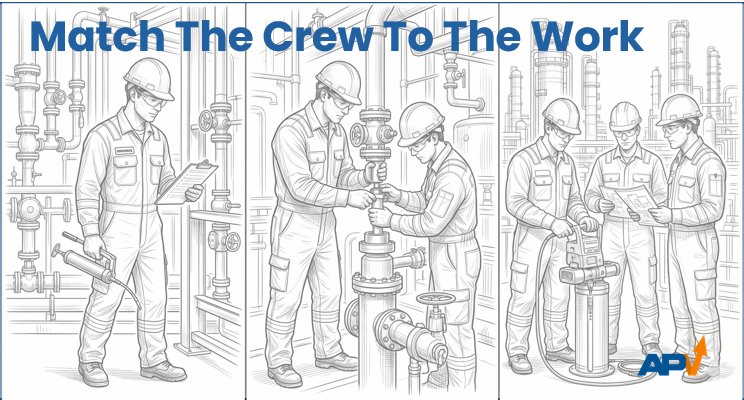
Routine work covers recurring PMs, scheduled lubrication routes, filter and consumable replacements, visual inspections, and tasks that are procedurally defined, tool-light, and skill-repetitive. The defining characteristic is that a trained apprentice or helper following a written procedure can complete the work safely and correctly without constant journeyman oversight.
Routine work benefits from high apprentice-to-journeyman ratios. The journeyman's role shifts from wrench-turner to route supervisor and quality verifier.
Minor corrective work covers non-critical equipment repairs with defined failure modes, component replacements on familiar equipment, and corrective tasks where the failure cause is known and the repair path is standard. These jobs typically need a journeyman leading the work with an apprentice as second craft. The 1:1 pairing that handles both skill execution and active development at the same time.
Complex corrective and specialty work covers diagnostic repairs with unknown failure modes, high-consequence equipment with significant safety or production exposure, work requiring specialty tools, statutory compliance activities, and any task where a wrong decision propagates into a much larger problem. These jobs warrant full journey-level crews and experienced lead craft. This isn't the category where cost optimization should drive the decision.
Why The Distinction Matters For Planning
Where the planning function gets real traction on crew mix is at work classification.
A planner who identifies a job as a routine task and documents the appropriate crew configuration, one journeyman supervising two apprentices, for example, has given the scheduler and supervisor everything they need to make a cost-appropriate staffing decision.
Without that classification in the work package, the default will be whatever crew is most available. Which is typically a journeyman doing work that didn't require one.
This isn't a minor variance. A plant with 50 active maintainers running an unexamined crew mix on routine work is probably carrying 8 to 10 misallocated journeyman-hours per day. Labor that could be handled by apprentices at lower cost, freeing journeymen for work that actually requires their skill level.
Across 250 working days, that adds up fast.
Ratio Frameworks By Work Type
These are working frameworks, not absolutes. Union agreements, site safety requirements, and apprentice skill progression all adjust the specific numbers. As a planning baseline:
Routine PM and lubrication work runs 1:2 to 1:3 journeyman-to-apprentice, with a journeyman serving as route supervisor. Procedure-dependent. Higher ratios are viable for late-stage apprentices.
Minor corrective work runs 1:1 with a journeyman lead. Active skill transfer. The journeyman makes the repair decisions while the apprentice executes a defined portion of the work.
Moderate corrective work also runs 1:1 but with a senior journeyman in the lead role. There's a diagnostic component. The apprentice assists, observes, and absorbs system-level thinking they can't get from procedure-only work.
Complex corrective and specialty work runs all-journeyman with a senior journeyman or foreman in the lead position. Quality and safety drive the ratio, not cost.
Turnaround and STO scope varies widely by task type. Scope documents should specify classification per work package. This is one of the places where front-end planning rigor pays back the hardest.
The Classification Habit
Building work-type classification into the standard planning process is a one-time structural change with permanent cost and quality returns.
Add a single field to the work order template. Work complexity classification: routine, minor corrective, or complex corrective. That field gives planners the structure to document the recommendation and schedulers the information to act on it.
The organizations that handle this well don't treat it as a special crew mix project. They treat it as part of how a work package gets built. That habit, consistently applied, turns crew mix from a concept into a managed variable.
That's the logic MODEMO® CrewSpec is built around. Work-type classification, recommended crew composition, and the documentation that connects the two, all sitting inside the job package the scheduler already opens.
The Bottom Line
The same crew shouldn't handle every job. The work isn't the same. The skill required isn't either. The cost shouldn't be the same number on every line.
A static crew composition assigned across all work types is a planning decision made by default. It's invisible until someone looks at it. Once you do, it's hard to unsee.
The next post in this series covers how strategic crew mix becomes the delivery mechanism for apprentice development. At a time when the skilled trades pipeline is contracting faster than most facilities want to acknowledge, that connection matters more than ever.
John Crager is Vice President and General Manager at APVantage LLC. He has spent more than 30 years in industrial maintenance, capital project, and turnaround operations.
APVantage helps industrial organizations optimize their maintenance execution practices by helping teams not only understand the problem but develop solutions that actually fit their unique situations.