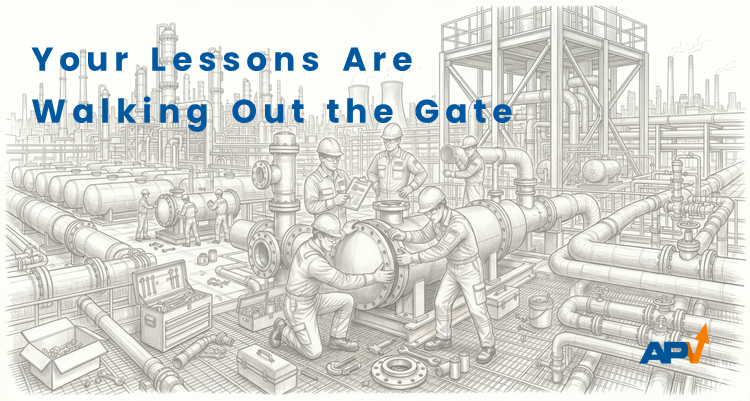
Your Lessons Are Walking Out the Gate. Stop Them Now.
Written on: April 23, 2026
Your 2027
Plan Depends on What You Do Right Now.
Somewhere in your organization, a turnaround just wrapped. The punch list got cleared. Startup went reasonably well. Everyone moved on to the next thing.
The final cost report is sitting in someone's inbox. Your field coordinators have already been redeployed. The contractors are gone.
And the most valuable data your 2027 planning team will ever see is evaporating right now.
I've watched this pattern play out at refinery after refinery, petrochemical site after petrochemical site, for more than thirty years. It's not that anyone decides lessons learned don't matter. It's that nobody owns the capture process before the people who lived the event are gone.
Why 2025 and 2026 Created an Unusual Gap
Fourth quarter of 2025 was one of the heaviest maintenance windows many facilities have seen in years. 2026 is tracking the same way. Refineries and petrochemical plants across the U.S. have either just wrapped major events or are still executing them right now.
So your organization is sitting on an unusually dense layer of field knowledge built up over the last six months. Equipment that behaved differently than the plan said it would. Contractors who performed better or worse than expected. Scope assumptions that turned out wrong. Permit workflows that bottlenecked crews. Coordinators who caught problems that never made it into any report.
None of that lives in your CMMS or P6. Almost none of it survives intact to make a positive impact in 2027 planning unless someone captures it on purpose, right now, while the people carrying it are still reachable.
Where the Knowledge Actually Lives
Three places. Each one loses the knowledge on a different clock.
Your field workforce carries the most granular layer. Technicians and coordinators who lived the hard moments of the event know things no cost report reflects. Which isolation points caused the worst delays. Where the schedule-versus-reality gap first opened up. What the best coordinators did differently when conditions shifted. That knowledge walks out the gate with the workforce when the event closes. By the time 2027 planning starts, most of those people are on other jobs, other facilities, sometimes other companies.
Schedule variance data tells a different story. Every event generates a gap between the plan and what actually ran. The data shows precisely where the assumptions broke down: which work packages took longer than estimated, which crews were undersized, which critical path activities had hidden dependencies nobody saw until they hit. Most organizations file the data in a closeout report nobody reads until the next event is already being planned. By then, the context that explains the numbers is gone.
Cost overrun detail is the third layer. Line items that drove budget variance in a 2025 or 2026 event are a direct map to where your 2027 estimate needs to change. Demobilization overruns. Redundant equipment. Unplanned scope additions. Specific, documented patterns that get ignored almost every time the next estimate gets built. Estimators pull the same baseline. The same surprises follow.
Fall Is Already Too Late
Most organizations treat lessons learned as a fall activity. Something to capture during the post-event review before the year closes out.
Fall is too late.
The coordinators and field engineers who can explain why the schedule slipped in Unit 3 are redeployed by August. The contractor supervisors who knew which work packages were actually at risk before the morning reports showed it are on their next project by July. The operations team that managed startup complications has already moved on mentally to the next event.
Spring and early summer is when the capture window is actually open. People are still reachable. Details are still fresh. Institutional memory hasn't diffused yet.
Miss the window, and your lessons learned document becomes a collection of general observations that could apply to any event at any facility. It stops being intelligence. It becomes noise.
Three Things That Actually Work
First, run a structured debrief while the team is still assembled. Not a high-level post-mortem. A specific, documented conversation at the work-package level about what the plan assumed and what execution revealed, area by area. Do it before coordinators redeploy, before contractors demobilize their supervision, before operations moves on.
Second, name an owner for the capture process. Lessons learned don't happen because they're important. They happen because someone owns them. Identify the person before the event ends, with a specific deliverable and a deadline tied to contractor availability, not to the fiscal year calendar.
Third, build a translation step from data to 2027 inputs. A lessons learned document that doesn't change the next planning cycle is just documentation. Every item captured needs a direct answer: Does this change the scope assumption? Does this change the estimate? Does this change the contractor strategy? If it doesn't feed the next plan, it didn't matter.
The Bottom Line
2025's fourth quarter and 2026's turnaround season are generating more field intelligence than most facilities have seen in years. The organizations that execute 2027 and 2028 events better won't be the ones with the most advanced software or the most updated procedures. They'll be the ones that captured what this year actually taught them before the people who know it moved on.
The window is open right now. In October, it won't be.
John Crager is Vice President and General Manager at APVantage LLC. He has spent more than 30 years in industrial maintenance, capital project, and turnaround operations.
APVantage helps industrial organizations optimize their maintenance execution practices by helping teams not only understand the problem but develop solutions that actually fit their unique situations.