The Crew You Were Promised vs. The Crew That Shows Up
Written on: March 03, 2026
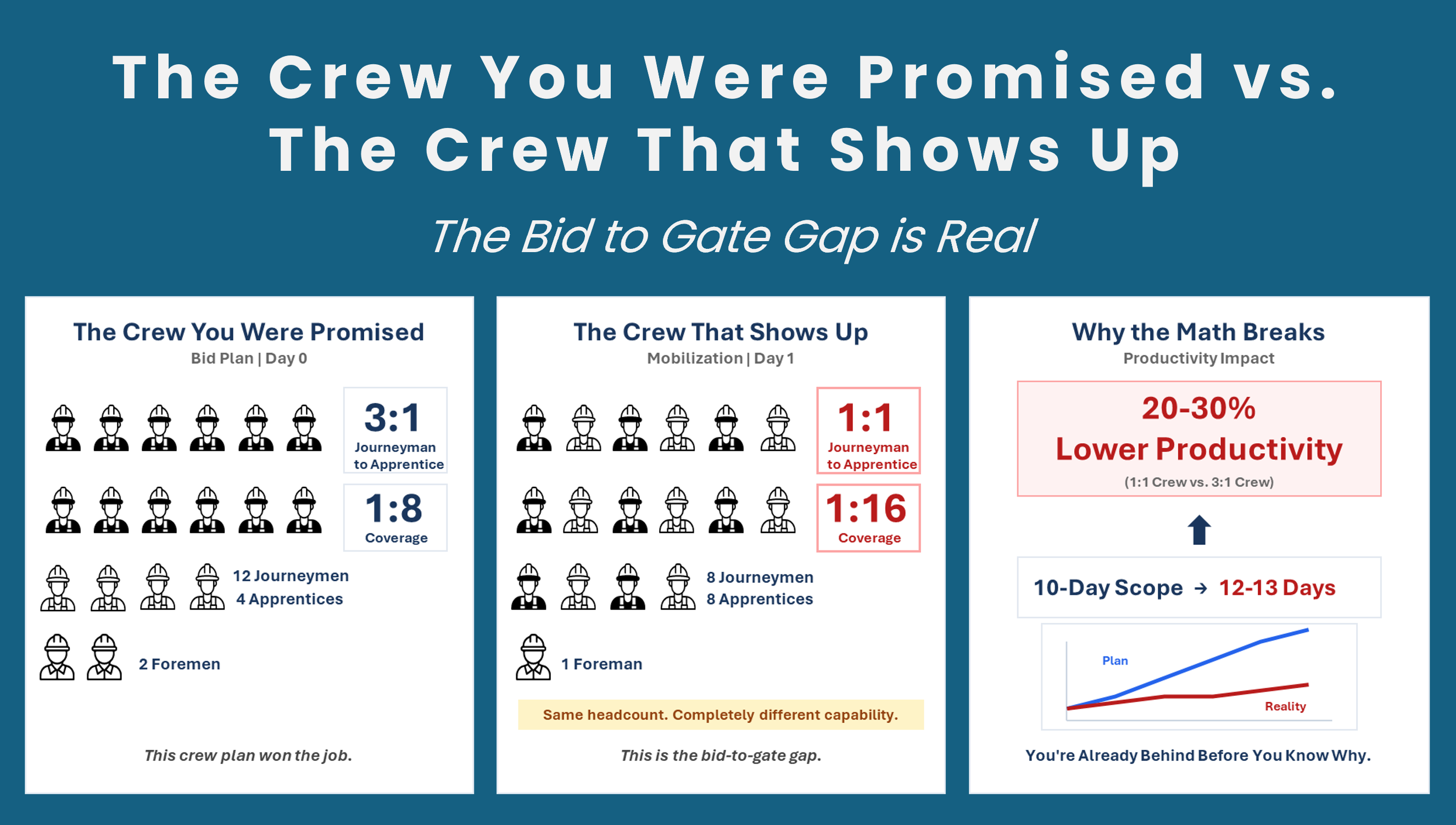
The proposal showed 12 journeyman pipefitters, 4 apprentices, and 2 foremen. A solid 3:1 ratio with proper supervision. You awarded the contract based on that crew plan.
What showed up: 8 journeymen, 8 apprentices, and 1 foreman. Same headcount. Completely different capability.
This is the bid-to-gate gap. And I've stood on both sides of it.
As an owner, I've watched carefully planned turnarounds lose momentum because the crews that arrived couldn't produce at the rates we'd planned. We built schedules around 3:1 journeyman ratios and got 1:1. We assumed foreman coverage at 1:8 and got 1:16. The math didn't work, and we spent the first week figuring out why we were already behind.
As a contractor, I've lived the other side. You bid with your best available crew plan. Then the market shifts. Another project pulls your lead foreman. Two journeymen take better offers. Someone gets sick. You're scrambling to fill slots with whoever's available because showing up short-handed is better than not showing up at all.
Neither side is acting in bad faith. But the gap is real, and it costs owners millions in productivity losses they didn't plan for.
A 1:1 crew doesn't produce like a 3:1 crew. You're looking at 20-30% lower productivity. A 10-day work scope becomes 12-13 days. And if you don't catch it until you're watching earned value reports slip, you're already behind with no time to recover.
Here's what owners can do to close the gap:
- 1. Specify crew composition in the contract, not just the bid.
Don't treat the crew plan as informational. Make journeyman-to-apprentice ratios and foreman coverage contractual requirements by trade. When it's in the contract, you have a basis for conversation when actual crews don't match. When it's just in the proposal, it's a suggestion that got lost in the shuffle.
- 2. Require crew rosters 30 days before mobilization, not at the gate.
The contractor knows who they're planning to send well before Day 1. They know at Day -30 when they're finalizing assignments. Get that information while there's still time to act. If the roster shows 8 journeymen instead of 12, you can have a conversation, require substitutions for critical positions, or at minimum adjust your productivity expectations before you're already behind.
- 3. Track compliance, not just headcount.
Knowing you have 16 pipefitters isn't enough. You need to know the mix. Build crew composition tracking into your project reporting alongside cost and schedule. When you see a contractor at 62% compliance on CrewSpec requirements at Day -30, that's escalation time. Waiting until Day 1 means you've already lost the ability to influence the outcome.
Contractors face real market pressures. Labor is tight. Projects compete for the same workers. Availability changes between bid and mobilization. That's not going to change.
What can change is when you find out about it. Discovering the gap at Day 1 leaves you no options. Discovering it at Day -30 gives you time to address it, adjust for it, or at least plan around it.
The bid-to-gate gap is real. But it doesn't have to be a surprise.
This is exactly why we built crew composition tracking into MODEMO®. Not to catch contractors doing something wrong, but to create visibility early enough that both sides can work the problem together. Learn more at: https://modemo.ap-vantage.com.
John
© 2026 APVantage LLC
© 2026 APVantage LLC